Sunday, April 12, 2026

Career Summary


Biologist | Virtual Writing Tutor

Biologist

Introduction

If you have ever thought about being a biologist, this article is for you. You will learn more about this job and all of his great opportunity this job can give to someone.


What is it like to be a biologist?

Being a biologist is a mix of curiosity, problem-solving and discovery. Biologists spend their time trying to understand living organisms and how life woks.


What do biologists do?

Biologists study living organisms such as plants, animals, and microorganisms. They research how these organisms function, evolve, and interact with their environment. Their work can lead to environmental protection, medical discoveries and technological innovations.


What do biologists do on a typical day?

A typical day for a biologist may include to conducting experiments in a laboratory, collecting samples or data in the field, analyzing results using computers and writing reports or scientific papers.


Where do biologists work?

Biologists work in many environments such as laboratories, universities and research centers, government agencies, private companies and in the most time, the outdoor environments like forest and oceans. They usually work in the laboratories during the winter and in the outdoor during the summer.


How can I become a biologist?

To be a biologist, you usually need a bachelor's degree in biology or a related field, often a master's degree or PhD for advanced positions and practical experience in the lab and in the field. Higher education is important because the filed requires strong scientific and analytical skills.


How much money do biologists make?

In Canada, biologists typically earn between about $53,000 and $138,00 per year, with an average around $83,000 annually. Salary depends on experience, specialization, and workplace.


What kinds of additional training do biologists need?

Biologists often need lab techniques and data analysis skills, fieldwork skills like being fit for outdoor research.


What are the dangers of being a biologist?

Some risks include exposure to chemicals or biological hazards in labs, working with dangerous animals or pathogens and difficult terrain during field works. However, safety protocols are usually in place to reduce these risks.


What are the chances that biologists will be replaced by robots soon?

There is no chance that biologist will be replaced by robots. Technology can help during with data analysis but biology requires critical thinking, creativity, and decision-making those robots cannot replicate.


What age do biologists retire at?

Most biologists retire around the standard retirement age so about 60-65 years old, depending on their health and career situation. Biologists needs to be able to go to difficult field that can't be done in a certain age.


Conclusion

I am finishing my study to be a biologist in the next year, and I'm very exited to explore nature and the life of the world.


Sources and RADARS ratings

Source: https://www.careerexplorer.com/careers/biologist/

Rationale: to inform or educate

Authority: research journal

Date: still relevant

Accuracy: probably true

Relevance: relevant for this document

Sources: cites sources


Source: https://www.fredonia.edu/academics/insights/what-is-a-biologist

Rationale: to inform or educate

Authority: research journal

Date: still relevant

Accuracy: probably true

Relevance: relevant for this document

Sources: cites sources


Source: https://askabiologist.asu.edu/explore/whats-biologist

Authority: research journal

Date: still relevant

Accuracy: probably true

Relevance: relevant for this document

Sources: cites sources


Statistics

Word count: 373

Error count: 0

**************************************************************

Sunday, March 8, 2026

Screencast

How to find the Latin name of a plant species

Introduction

Hello everyone! My name is Olivier and my program in cegep is Environmental and Wildlife Management Technique. Today I will show you how to find the Latin name of a plant species using the VASCAN website.

Like many students in biology or environmental programs, we often need the scientific name of plant for school assignments or research. Sometimes, it can be difficult to find reliable information.

I have to admit that at first I also had difficulty finding the correct Latin names for plants online.

However, during my studies in environmental and wildlife management, I learned about reliable scientific databases like VASCAN.

In this video, my goal is to show you how to easily find the Latin name of a plant species.

Get ready to follow my step-by-step tutorial.

The Problem

First, let me explain the problem. When students search for plant species on the internet, they often only know the common name of the plant.

However, common names can be confusing because the same plant can have different names depending on the language or region.

For example, in French we say érable à sucre, but scientists use the Latin name Acer saccharum.

It can be difficult to use the Latin names. But don't worry. VASCAN is here to help you.

The Quest

First, open your internet browser and type VASCAN website.

Now let's take a quick tour of the VASCAN homepage. At the top of the page, we can see the navigation menu, which allows users to access different sections of the website. Just below the title, there is a search bar where you can type the name of a plant species. This is the main tool used to find information about plants. If we scroll down, we can see additional information about the website, including links, references, and updates about the database.

The Solution

First, type the common name of the plant in the search result that matches your plant. On the species page, you will see the Latin scientific name of the plant, along with additional information such as its classification and distribution in Canada.

The Conclusion

So, if you are in an environmental field of study, that's how you can find the scientific name of a plant.

**************************************************************

Statistics

Word count: 373

Total MP3 length: 02:29

Target structure count: 4

Error count: 16

Error density: 5%

Screencast

Thursday, February 12, 2026

Biology Glossary


Environmental and Wildlife Glossary

Biology and nature vocabulary can be difficult! When we write documents about wildlife content, it's not easy to use the words correctly. Here are 20 terms you can use if you have to talk about nature.

biodiversity
noun
The variety of life in the world or in a particular habitat or ecosystem.
Example: Predators are always at the top of the food chain, without them BIODIVERSITY's wouldn't be as they are.
en: biodiversité
ecosystem
noun
A dynamic community of living organisms (biotic components like plants, animals, and microbes) interacting with each other and their non-living physical environment (abiotic components like sunlight, soil, water, and air) in a specific area.
Example: Downstream, a reduced flow rate may have a significant effect on the aquatic ECOSYSTEM- up to 35% of fresh water fish are thought to have become extinct or endangered as a result of dams.
en: écosystème
 <https://creativecommons.org/licenses/by-sa/4.0>, via Wikimedia Commons
habitat
noun
The natural home or environment of an animal, plant, or other organism.
Example: However, this method is a good measurement to study on the relationship between the distribution of species in a certain area and the HABITAT. 2) Line transects The chosen transects in the area are walked or driven by observers within a set period of time in this method.
en: habitat
food chain
noun
A hierarchical series of organisms each dependent on the next as a source of food.
Example: The remaining amount is released into surrounding ecosystems and enters the FOOD CHAIN, affecting animal populations at every trophic level.
en: chaîne alimentaire
chris 論 (through works of J. Patrick Fischer, C. Schuhmacher, Madprime, Luis Fernández García, Luis Miguel Bugallo Sánchez, chung-tung yeh, Susanne Heyer and Simon Andrews), CC BY-SA 3.0 <http://creativecommons.org/licenses/by-sa/3.0/>, via Wikimedia Commons
food web
noun
A complex, interconnected network of multiple overlapping food chains, illustrating the various pathways that energy and nutrients take through an ecosystem.
Example: This has been known to cause problems further up the FOOD WEB due to the accumulation of toxins in top carnivores.
en: réseau trophique
predator
noun
An animal that naturally preys on others.
Example: It is a topic in this area which we will seek to study in this paper, the topic being PREDATOR-Prey population interaction.
en: prédateur
prey
noun
An animal that is caught and killed by another for food.
Example: The animals that do appear are 'PREY' animals that would have been very common and part of life for the Palaeolithic hunter.
en: proie
decomposer
noun
An organism, especially a soil bacterium, fungus, or invertebrate, that decomposes organic material.
Example: Increased dead root material is a resource for DECOMPOSER organisms in the soil and could change microorganism community structure and act as subsequent source of nutrients for plant growth.
en: décomposeur
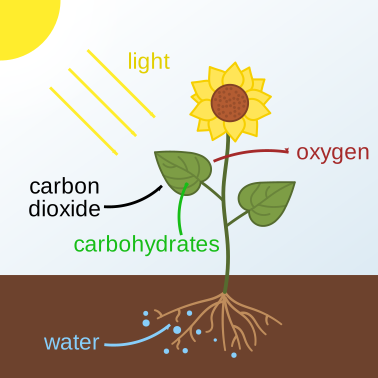
photosynthesis
noun
He process by which green plants and some other organisms use sunlight to synthesize foods from carbon dioxide and water. Photosynthesis in plants generally involves the green pigment chlorophyll and generates oxygen as a byproduct.
Example: For PHOTOSYNTHESIS to occur, there needs to be a supply of carbon dioxide, water, and light energy.
en: photosynthèse
At09kg, Wattcle, NefronusAt09kg: originalWattcle: vector graphicsNefronus: redoing the vector graphics, CC BY-SA 4.0 <https://creativecommons.org/licenses/by-sa/4.0>, via Wikimedia Commons
adaptation
noun
A change or the process of change by which an organism or species becomes better suited to its environment.
Example: Mutations can slowly add new genetic variation to populations and may produce novel phenotypic affects that selection can assemble into ADAPTATION.
en: adaptation
evolution
noun
The process by which animals, plants, and other living organisms are transformed into different forms by the accumulation of changes over successive generations.
Example: This hominid subsequently gave rise to all modern human populations, simultaneously in multiple regions, through a process of in situ EVOLUTION.
en: évolution
natural selection
noun
A fundamental mechanism of evolution where organisms better adapted to their environment tend to survive and produce more offspring.
Example: In his Origin of Species he explains how NATURAL SELECTION does not proliferate characteristics that are beneficial to another species, claiming that he 'would almost as soon believe that the cat curls the end of its tail when preparing to spring, in order to warn the doomed mouse'. NATURAL SELECTION is selfish.
en: sélection naturelle
population
noun
A particular section, group, or type of people or animals living in an area or country.
Example: There are large sugar estates which are for the most part owned by about 2 percent of the POPULATION - namely the Franco-Mauritians.
en: population
species
noun
A group of living organisms consisting of similar individuals capable of exchanging genes or interbreeding.
Example: A ditch that caries excess water off the track is presently overgrown by bramble SPECIES.
en: espèces
ecological niche
noun
The range of resources and conditions allowing the species to maintain a viable population.
Example: Consequently, the species are of medium size, lightly built, slender and long limbed (Fig 3), all of which means they are perfectly adapted to moving quickly in their present ECOLOGICAL NICHE.
en: niche écologique
symbiosis
noun
Interaction between two different organisms living in close physical association, typically to the advantage of both.
Example: Both hypotheses agree in the suggestion of an anaerobic metabolism for the origin of mitochondrial SYMBIOSIS.
en: symbiose
mutualism
noun
Symbiosis that is beneficial to both organisms involved.
Example: There is a spectrum of symbiosis: Commensalism -where only one of the organisms benefits but does not harm the other to any significance, MUTUALISM -where both symbionts benefit, and finally Parasitism -only one organism (here called the parasite) benefits from the relationship but at the detriment of the host.
en: mutualisme
Rashmi H Pardhi, CC BY-SA 4.0 <https://creativecommons.org/licenses/by-sa/4.0>, via Wikimedia Commons
parasitism
noun
The practice of living as a parasite in or on another organism.
Example: PARASITISM -only one organism (here called the parasite) benefits from the relationship but at the detriment of the host.
en: parasitisme
Hall Wild, CC BY-SA 4.0 <https://creativecommons.org/licenses/by-sa/4.0>, via Wikimedia Commons
competition
noun
Interaction between organisms, populations, or species, in which birth, growth and death depend on gaining a share of a limited environmental resource.
Example: 'Female COMPETITION-conditional transfer', where male dispersal is influenced by female spatio-temporal distribution (Altmann, 1990) is therefore common.
en: compétition
climate change
noun
A change in global or regional climate patterns, in particular a change apparent from the mid to late 20th century onwards and attributed largely to the increased levels of atmospheric carbon dioxide produced by the use of fossil fuels.
Example: Although 'CLIMATE CHANGE' has become synonymous with 'global warming' scientists use the term in a wider sense including also natural changes in climate.
en: changement climatique
Tommaso.sansone91, CC0, via Wikimedia Commons

About me and my love for nature!

Hi, my name is Olivier Desilets, I live in Sherbrooke and my program in cegep is the Technic of Environmental and Wildlife Management. I chose this program because I love my surroundings, especially nature. I like being outdoors, so this program meets all my criteria! In this program, we learn about plants🌳 and animal species🐙, such as insects🐞, mammals🐒, birds🐦 and fish's🐠. Its my second years in this program and I still love it.


Career Summary

  Biologist | Virtual Writing Tutor ...